Workflow Loop Detection in Production Agents
Fingerprints in execution traces reveal why production agents get stuck in loops.
Agent loops are now a distinct, diagnosable failure category." Repeated spans, identical argument hashes, and flat progress toward the goal appear in production traces, and they cost real money before anyone notices. A max-turn cap will stop the bleeding eventually, but it tells an engineering team nothing about why the agent got stuck. The same failure ships again next week.
Where loops fit inside the broader agent failure landscape
The reason-act-observe cycle is the basic unit of every agent step: the model reasons about what to do, takes an action, observes the result, and reasons again. A loop happens when that cycle stops producing anything new. The agent repeats a step, retries a tool call that already failed, or hands a task back and forth between two sub-agents without either one advancing the work. None of this is about runtime alone. A workflow that legitimately takes 40 steps is fine. A workflow that takes 40 steps and ends exactly where it started at step 10 is not.
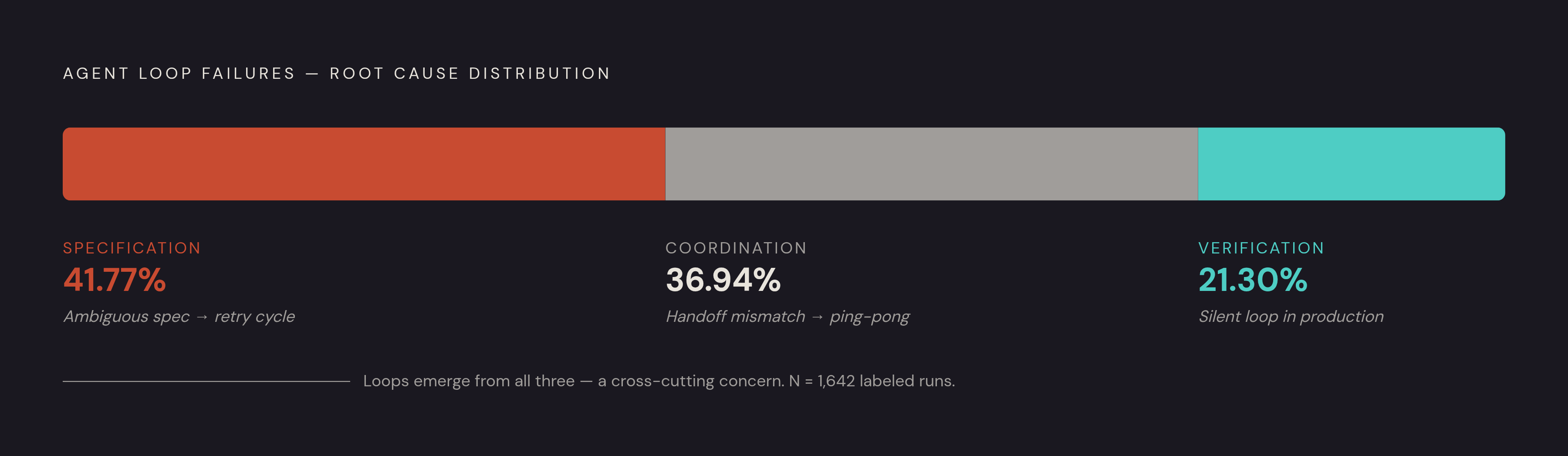
A taxonomy built from roughly 150 annotated multi-agent traces, published alongside a dataset of 1,642 labeled execution runs at NeurIPS 2025, breaks agent failures into three buckets. Specification problems, meaning role ambiguity, vague task definitions, missing constraints, account for the largest share, at 41.77%. Coordination failures, communication breakdowns and conflicting objectives between agents are 36.94%. Verification gaps, meaning nobody built an eval that would have caught the problem, make up 21.30%.
Loops do not belong to just one of those categories. They cut across all three. An ambiguous spec sends a planner into a retry cycle because it does not know when the task counts as done. A coordination failure produces the ping-pong handoff where two agents keep passing a clarification request between each other. A verification gap means the loop runs in production for days because no eval was watching for it. A separate 2025 analysis of multi-agent failure logs found that step repetition alone accounted for 17.14% of failures, with reasoning-action mismatches, where the model's stated intent does not match what it actually does, at 13.98%. Both of those slip straight past a check that only looks at the final output.
Infrastructure noise is a fourth, less formal category. Rate limits, context window overflows, cascading timeouts. These do not cause loops in the textbook sense, but they sustain them, turning a two-step retry into a twenty-step one. And because modern agent architectures are more complex than a single model call, with a planner, a retriever, a tool executor, a memory store, and a handoff policy all touching the same request, a single bad decision early on has more surfaces to propagate through than it used to. Loop detection, in that light, is not just a cost-control measure. It is a cascading-failure concern.
The trace signatures that identify a running loop
A loop leaves fingerprints, and they are specific enough to build detection around. The canonical pattern, as described in FutureAGI's Agent Loop Detection guide, is a high iteration count paired with the same tool name, identical argument hashes, repeated assistant intent, flat GoalProgress, and a rising timeout rate. In an OTel-instrumented stack, one pass through the loop shows up as an LLM-reasoning span, an action span, and an observation-update span. Seeing that trio repeat with no change in state is the structural signature of a stuck agent, independent of what the actual task was.
Five distinct signatures appear in practice, and each one points to a different cause. Same tool, same arguments, null result, usually means the agent is querying against bad or missing data and never got a signal telling it to try something else. Same tool, same arguments, same error means the tool is down or its schema no longer matches what the agent expects, and the agent is retrying a contract that's already broken. The same reasoning intent repeating across turns points to a stuck chain, where the prompt or planner isn't actually processing what came back from the last step. Bouncing between two different tools suggests the planner can't decide between them, often because their descriptions overlap. And a ping-pong handoff between two agents means nobody defined who owns resolution when the task is ambiguous.
At the population level, four metrics expose loops before a customer ever complains: iterations-per-trace at the p95 and p99 mark, token cost per trace, timeout rate, and eval-fail-rate broken out by cohort. User-facing signals like thumbs-down rate or session abandonment confirm the problem eventually, but they lag well behind the trace data, sometimes by days.
Thresholds have to be set per workflow. A search agent, a refund agent, and a coding agent have different normal step counts, and a single global iteration cap will flag a perfectly healthy long-running task as a failure. On τ-bench, Anthropic's multi-turn customer support benchmark, iteration counts on failed runs cluster two to three times above the median, which is exactly the kind of gap a threshold calibrated to the median is built to catch without punishing the outliers that are actually fine. GoalProgress is the signal that separates a legitimate long task from a stalled one: if it's flat after step N and the action signatures are repeating, the loop is confirmed, even when every individual step, in isolation, looks syntactically correct.
Tool schema drift as a silent loop trigger teams routinely miss
An agent reasons entirely from a tool's schema. It never sees the code behind the API, so it has no way of knowing if that implementation changed since the last time it called it. That gap is where a specific and underappreciated loop trigger lives.
Schema mismatches and description drift are not the same failure, and conflating them is a mistake. A schema mismatch throws a runtime error. It's visible, and it's catchable in testing. Description drift is quieter: the human-readable text describing what a tool does stays the same, but the underlying parameters or behavior shift. No type checker catches that, because nothing about the type signature changed. Researchers documenting MCP tool definitions in September 2026 found exactly this pattern across public servers: descriptions stayed word-for-word identical while the parameter fingerprints they relied on drifted. An agent that only reads the description has no way to know anything is wrong.
Scale matters here. Over 13,000 MCP servers went up on GitHub in 2025 alone, and the protocol spec does not require audit, sandboxing, or verification of any of them. Drift isn't an edge case in that environment, it's closer to an inevitability.
FutureAGI's reporting sorts production schema drift into four failure modes, each with its own loop shape. Wrong-args happens when the argument shape no longer matches the tool's schema, and the agent, having no better information, keeps retrying with the same shape, producing the classic same-tool-same-args loop. Tool-hallucination is the agent calling a function that doesn't exist in the runtime catalog at all, generating repeated failed calls against nothing. No-error-handling is the ugliest version: the tool returns a 500, the agent fails to surface that and instead fabricates a plausible-looking response on top of the failure, producing a silent stall with no error and no obvious sign anything went wrong. API-drift covers the case where a third-party endpoint changes its schema or error codes but the CI mock keeps returning the old response, so the loop is invisible until it's already live.
In a multi-agent system, one drifted tool doesn't stay contained. An orchestrator delegating work downward propagates the failure of that one tool into every subtask that depended on it.
The mitigation that works structurally, rather than reactively, is a schema registry: a stored, approved fingerprint for every tool, keyed to its name and server endpoint. CI computes a fresh fingerprint on every deployment and compares it against the registry, halting the release if anything differs until a human reviews it. That solves structural drift. It does not solve description drift, which changes meaning without changing structure, and that still needs a human doing semantic review, not just a diff.
Why root cause attribution matters for loop recovery
Traditional software fails in code. Agent failures are buried inside long, language-heavy execution trajectories full of natural-language reasoning, which makes root cause a genuinely harder problem to solve than a stack trace ever was. And there's a specific failure mode in how LLMs themselves try to do this attribution: as the trace grows longer and more distributed across agents, the model doing the diagnosis tends to settle on whatever explanation looks plausible first, rather than working through the full evidence.
AgenTracer-8B, a model built specifically for this kind of diagnosis, illustrates the problem well. In one documented case from 2026, it correctly traced a failure back to step 2, where a Web Surfer agent pulled a file with the wrong date on it, an error that only became visible when the evidence at step 11 was examined against it. Nothing about step 2 looked wrong on its own. It only became a root cause once someone, or something, connected it to a much later symptom.
That difficulty is not theoretical. A two-year postmortem study at Zalando found a persistent attribution error rate of around 10%, where the diagnosing model blamed a technology simply because it happened to be mentioned somewhere in the incident thread, not because it was actually responsible.
Recent work is closing that gap, gradually. AgentDebugX, using a method called DeepDebug that reasons over the global trajectory rather than a single pass, reaches 28.8% exact agent-and-step attribution accuracy on the Who&When benchmark using a 9B-parameter model, against 21.7% for the strongest single-pass baseline, in research from Zhu and colleagues. Who&When Pro, a 2026 benchmark from Liu and colleagues, expanded the evaluation surface to more than 12,000 labeled trajectories across different frameworks and domains, making it the broadest attribution testbed available so far. A separate framework called Continual Search takes an iterative approach, nudging the judge model across several turns so it keeps exploring evidence instead of stopping at the first plausible answer, and on the TRAIL benchmark it lifts GPT-5.5's weighted F1 score to 0.451, up from a weaker passive-continuation baseline.
Specificity in attribution is not academic. Closed-loop recovery, where the fix is grounded in the actual attributed root cause rather than applied at the point where the failure became visible, meaningfully outperformed decoupled self-correction approaches in the same research from Zhu and colleagues. Knowing a run failed is close to useless without knowing which layer, prompt, tool, workflow, memory, or planner, was actually responsible, because each one implies a completely different fix. Separately, ICSE 2025 research found that incorporating code-level knowledge into the diagnosis process improved root cause localization by 28.3% over the previous leading method, reinforcing that the more context an attribution system has, the less it guesses.
A systematic detection and response approach built on harness engineering
Detection is an eval problem and a trace problem at the same time, not a single max-iteration rule bolted onto the end of a run, and response has to match the layer where the failure actually originated rather than treating every loop the same way.
The controls belong in the harness. Sensors are the checks that run after the agent acts: evals, output parsers, GoalProgress scorers. Hooks are programmatic interception points, often called PreToolUse and PostToolUse, that can catch a repeated argument hash before the call even fires. Permissions and kill switches enforce policy deterministically before an action reaches the wire, an approach reflected in Microsoft's Agent Governance Toolkit as described by MLflow in May 2026, which makes a blocked action structurally impossible rather than merely discouraged. Orchestration handles depth caps on handoffs and resolution agents for coordination failures. Observability, meaning traces, token usage, and error rates, is the evidence layer feeding all of the above.
The workflow that makes this operational treats every loop signature as its own eval, returning a score and a reason rather than a plain stop signal. Loop detection evaluators get paired with a StepEfficiency score measuring wasted steps and a GoalProgress score measuring whether each step actually advanced the task. FutureAGI's guidance states that teams alert when loop failures cross 2% for a given cohort, and block a prompt or tool-schema release in CI outright if the same failure scenario regresses. Thresholds stay specific to the workflow type instead of living behind one global cap.
Response has to match the signature, because the same fix does not work for every loop. A same-tool-same-args loop calls for stopping after two identical failures and either requesting a new identifier or routing to a human. A stuck reasoning chain calls for a re-prompt or a model switch, alongside an actual look at whether the prompt itself is ambiguous. Overlapping tool descriptions that confuse the planner call for tighter descriptions and a few-shot example that disambiguates them. A ping-pong handoff calls for a depth cap plus a resolution agent with explicit ownership of the tie-break. A schema drift loop calls for the registry fingerprint check, halting deployment until a human signs off.
None of this ships without replay validation against historical traces first. A prompt change that fixes one loop pattern can easily introduce another, and shipping that change without checking it against past runs is shipping blind. MLflow's guidance also emphasizes structuring agent workflows so that failures are caught before they reach production, not just running batch analysis after the fact, because loops emerging from a new traffic pattern need to be caught while they're happening, not reviewed in next sprint's retro.
Architecture does some of this work on its own. When each sub-agent owns one clearly defined responsibility, a loop inside one of them doesn't propagate to the rest of the system, which makes containment an architectural property rather than something bolted on at runtime. Memory and skill hygiene also shape outcomes directly: a memory store that retains prior task outcomes can inform loop-avoidance strategy directly, and packaging "stop after N identical failures" as a versioned, reusable skill beats patching the same fix into a dozen different prompts by hand.
Building loop detection into the engineering workflow, not bolting it on afterward
Production traces are the most honest signal available for understanding how an agent actually behaves. Loop detection without real trace-level visibility isn't detection; it's a guess dressed up as a system.
A mature posture looks consistent rather than reactive. The schema registry gets checked on every deployment. Loop detection evaluators run in CI against historical traces as a matter of routine. And the team's own diagnosis process gets validated against attribution benchmarks like Who&When Pro and TRAIL, so that the confidence in a root-cause finding is earned rather than assumed.
Multi-agent systems will keep adding more layers, more handoffs, more places for a loop to start. That trajectory only makes trace-level engineering more necessary, not less. A schema registry, layered evals, and replay validation catches the same failure that an eleven-day, $47,000 loop slips right through when nobody is watching the trajectory, only the output.