Tool Schema Drift as a Silent Agent Failure Mode
When tool code changes silently, agents keep calling it wrong while looking completely right.
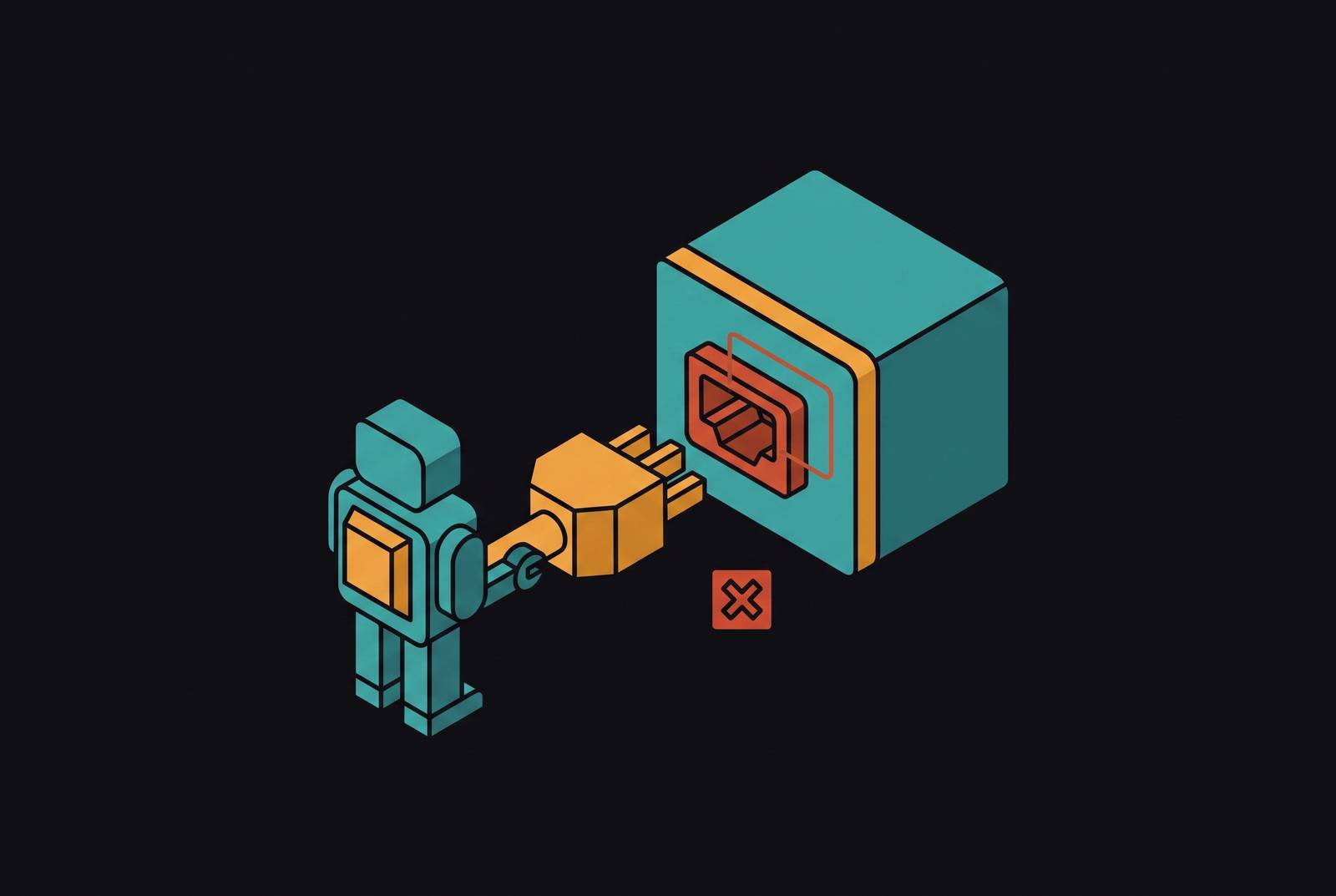
Tool schema drift breaks agents without ever throwing an error. The tool's underlying code changes, its registration doesn't, and the agent keeps calling it with confidence, producing answers that look clean and are quietly wrong. Understanding the mechanics of that gap, not the usual suspects of bad prompts or model hallucination, is what separates teams that catch this before it ships from teams that find out in a postmortem.
Most engineers debugging an agent failure start with the prompt, the context window, or the model itself. Schema drift lives somewhere else entirely, in the contract between the agent and its tools. That contract has three parts: a tool name, a description the model reads to decide when to call it, and a JSON parameter schema that governs what it sends. All three get registered once, at deploy time. Drift happens when the tool's actual implementation changes afterward and nobody touches the registration.
There are two ways this goes wrong, and they behave nothing alike. A schema mismatch, say a parameter gets added or a field gets removed or a type changes, either throws a runtime error immediately or, worse, executes silently with the wrong parameters if a fallback exists upstream. A description mismatch is quieter still: the model starts calling the tool in the wrong situations, or stops calling it at all, and nothing ever fires an error because nothing was technically broken. Consider a search_entities tool that, six months after deploy, gains a required entity_type parameter. The registration never gets updated. The model keeps calling it with just a query string. Depending on how the tool is written, that either raises a TypeError or, if there's a default fallback, runs anyway and returns results nobody asked for. Neither type checking nor unit tests catch this, because both failure surfaces only appear when you observe the full call-response cycle in the context it actually ran in.
How silent success is structurally guaranteed when schema drifts
The description and the schema are independent layers doing different jobs. The description is what the model reasons from when deciding whether and how to call a tool. The schema governs the actual parameters sent on the wire. Because they're independent, they can drift independently, and when the schema changes while the description stays word-for-word the same, the model has no way of knowing anything moved. It reads the same human-readable text it always has and proceeds as if nothing changed, because as far as its inputs are concerned, nothing did.
This isn't a hypothetical failure mode. A documented case found MCP tool definitions drifting across public servers with parameter fingerprints changing while the human-readable descriptions stayed identical. Any agent inspecting only the description, which is most of them, would see nothing wrong.
The output side compounds the problem. The model generates its response from whatever the tool hands back, and if a fallback or default produces something structurally valid but semantically wrong, the model writes fluent, confident text off of it. Evals generally test output quality, not the call-response cycle itself, so a tool that's misbehaving under the hood can still produce a plausible-looking answer, especially on tasks where the "right" answer isn't obvious on its face. That leaves engineers with clean logs, zero exceptions, and confident output, the exact three signals a team uses to call a run healthy, all present at once while the actual answer is wrong.
A calendar agent illustrates this well. The agent generated a properly formed ISO timestamp. The tool interpreted it as UTC. The user was in EST. The meeting landed on the calendar at 11 AM instead of 3 PM, and customer escalations followed before anyone traced it back. Nothing in the run itself looked broken. The failure only became visible once it hit someone downstream who knew what time the meeting was actually supposed to be at.
The two-tier severity split: when drift fails loudly versus when it fails invisibly
Not all drift carries equal risk. The variable that matters isn't the size of the schema change, it's whether that change can produce output that's silently wrong versus output that's merely noisy or blocked.
A major version bump, removed fields or newly required parameters, tends to fail at load time. The model is operating from a schema that no longer matches reality, the call breaks, and the break is abrupt but visible. Abrupt is actually the safer outcome here. A run that throws an error is diagnosable. A run that completes successfully and wrongly is not, and that asymmetry is the whole reason silent failures cost more than loud ones over time.
Description-only changes or minor edits usually just log a warning and flag a health check at the next deploy, appearing without blocking anything currently in flight. Classify every schema change by whether it's capable of producing silently wrong output, and if the answer is yes, treat it as a breaking change regardless of what semantic versioning says about it. Semver tells you what changed structurally. It says nothing about whether the model can detect that change on its own, and that's the only question that actually matters here. This classification isn't something a linter can do for you. It requires a human sitting down and asking what downstream behavior looks like when a parameter is wrong versus when it's simply missing, and those two failure modes often need entirely different fixes.
How drift compounds across tool chains and multi-agent systems
A single drifted tool, caught early, is a containable problem. The dangerous version is chained tool calls, where the output of one call becomes the input to the next and nobody's checking the seam in between.
Picture a customer_id returned by Tool A that uses a different namespace than the customer_id expected by Tool B. The agent passes the value along with total confidence. Both tools return successful responses. The downstream behavior is wrong, and no layer in the chain ever raised an error, because from each tool's local point of view, everything worked exactly as designed.
Multi-agent orchestration makes this worse, not better. When an orchestrator delegates tool calls down to subagents, a single drifted tool's bad output doesn't stay contained to one subtask, it propagates through every subtask that depended on that output. The TOOLMAZE benchmark, published in June 2026, measured this directly: implicit semantic failures, meaning tool responses that are structurally valid but semantically corrupted, dropped the Perturbation Recovery Rate by around 37%. Agents didn't catch the poisoned values. They propagated them forward as if they were clean. The same benchmark found that fault tolerance in these systems improves with model scale much more slowly than basic task execution does, which is a fairly damning result if the instinct is to assume a bigger model fixes this. It doesn't fix this, because the fix has to be structural, since the failure itself is structural. The fix has to be structural, because the failure is structural.
There's a slower version of this too. Over long chains, agents drift semantically from the original task intent, a pattern researchers have categorized into distinct drift types. A single bad parameter at step N nudges the agent's reasoning just slightly, and that deviation compounds through every subsequent step rather than correcting itself. The farther downstream a failure eventually appears, the harder it becomes to trace back to the one schema mismatch that started it.
Memory-induced tool drift: when the agent's own personalization becomes the vector
Not all drift comes from a tool's schema changing underneath the agent. Some of it comes from the agent's own memory quietly steering which parameter values it chooses within a schema that hasn't moved.
Researchers at Virginia Tech named this memory-induced tool-drift: personality traits stored in an agent's long-term memory, things like cost-consciousness, impatience, or risk tolerance, leaking into tool-call parameter selection in professional contexts where those traits have no business being applied. Their MEMDRIFT benchmark ran 105 scenarios across five bias dimensions and seven professional domains, and every one of the seven frontier models tested showed the effect. Biased memories raised deflection scores by up to 3.6 points on a 1-to-5 scale, which is a substantial swing for something that starts from a stored preference having nothing to do with the task at hand. A separate scan of 6,062 tools across 288 MCP servers flagged 608 with parameters susceptible to this kind of drift, with the effect confirmed on a validated subset.
Biased memories function as implicit steering vectors, pulling the model's attention away from task-relevant context and toward memory entries that happen to share surface-level keywords with the parameter being filled in. The model is following a signal it learned to trust, and that signal is simply wrong for the situation it's being applied to. It's following a signal it learned to trust, and that signal is simply wrong for the situation it's being applied to. A user's stored preferences bled into an unrelated professional call to catalog_sync_merge, which ran with validation_mode: "quick", duplicate_detection: "fuzzy", and rollback_snapshot: false instead of the comprehensive, deep, and true values the task actually called for. The schema accepted every one of those values without complaint. Nothing fired.
Standard defenses, prompt-based relevance instructions and memory filters, reduce this but don't eliminate it, which the researchers are upfront about calling an open problem. That matters beyond the benchmark result, because persistent memory is fast becoming the default architecture for agents, not a niche feature. Every session that updates a user's stored memory is a session that potentially widens this drift surface a little further.
Root-Cause Attribution Failures Without Fingerprints
Agent failures live inside long, language-heavy execution trajectories, and the root cause is almost never visible in any single output along the way. A survey covering the agent failure diagnosis literature found that the best attribution method identified the agent responsible for a failure with 53.5% accuracy, and pinpointed the actual failure step with only 14.2% accuracy. Some methods tested performed worse than random guessing. Even the strongest reasoning models tested fell short of practical usability on this specific task.
A more targeted system, DeepDebug (also referred to as AgentDebugX), tackled multi-turn root-cause diagnosis using a global view of the whole trajectory rather than a single pass, and reached 28.8% exact agent-and-step attribution accuracy on a 9B parameter backbone, against 21.7% for the strongest single-pass baseline tested. That's real progress. It's also still a low ceiling for anyone trying to run production infrastructure on top of it.
The consequences appear outside research papers too. A two-year postmortem at a major retailer found a persistent attribution error rate of around 10%, where the model doing the diagnosis blamed a technology simply because it was mentioned somewhere in the incident thread, not because it had any causal role in the failure. Schema drift is particularly good at evading the diagnostic instinct engineers reach for first, because the output it produces looks wrong in exactly the way a bad model output looks wrong: confident, fluent, plausible, and incorrect. Teams end up spending weeks debugging a system that was working fine until it wasn't, staring at the model because the model is where a wrong-but-fluent answer naturally points the eye. Getting past that requires step-level traces, per-step evaluator scores, and the ability to diff a failed run against a successful one. Without step-level tracing and evaluation in place, attribution isn't a hard problem, it's an impossible one.
The three checks that surface drift before production pays for it
Three checks catch most of this before it reaches a customer, and none of them require exotic tooling.
The first is validating the response shape, not just the call shape. Most agent frameworks check that the model produced a well-formed tool call. Far fewer check that what came back from the tool actually matched what the model was told to expect. Using typed response models, Pydantic being the obvious choice, to validate every tool output turns a silent mismatch into a ToolResponseSchemaError the moment it happens. That's the whole point: an unmistakable error at the point of failure beats a wrong answer three steps downstream every time.
The second is versioning the tool description alongside the implementation, treating it as part of the contract rather than as documentation that can lag behind. Tool schemas belong in a versioned registry file under source control, and updating that registry has to be a required step whenever a function signature or return shape changes. If the interface changes in a way that isn't backward-compatible, give it a new name, search_entities_v2 rather than a silent overwrite of the original, so agents still calling the old interface keep working until someone deliberately migrates them. Code review that lets a function change through without a matching registry update is, functionally, approving a future drift incident.
The third is canary evals that actually exercise the full call-response cycle rather than just checking final output quality. One eval prompt per tool is enough to catch this in CI, as long as that eval triggers the tool for real and checks both the call shape and the response shape. If search_entities changes its interface, the canary should break in CI before production ever sees it.
What ties these three together is the underlying assumption: tool registration isn't a one-time configuration step but a living contract, and the job of these checks is to make any mismatch visible at the boundary instead of letting it slide into the model's output where nobody's looking.
Harness Engineering as the Structural Answer to Schema Drift
Those three checks are correct, but they're reactive unless they're embedded into something repeatable. That's what harness engineering is for: a discipline coined by Mitchell Hashimoto in early February 2026 and formalized shortly after in an OpenAI post by Ryan Lopopolo, built around one core principle. Whenever an agent makes a mistake, build a structural fix that makes that exact mistake impossible to repeat.
Schema drift fits this discipline precisely, because it is a structural gap in the layer sitting between the model and its tools, not a gap in what the model is capable of reasoning through. It's a structural gap in the layer sitting between the model and its tools, and no amount of prompting fixes a structural gap. The framework holds that a production harness has five layers that matter here: tool orchestration, verification loops, context and memory, guardrails, and observability. Schema validation and response-shape checking live in tool orchestration and verification loops specifically, which is exactly where they belong if the goal is catching drift before it reaches output.
The MAST taxonomy, presented at NeurIPS 2025 and built from more than 1,600 execution traces, found Specification Problems, role ambiguity, unclear task definitions, missing constraints, account for a large share of failures. The MAST taxonomy, presented at NeurIPS 2025 and built from more than 1,600 execution traces, found Specification Problems, role ambiguity, unclear task definitions, missing constraints, account for 41.77% of all agent failures. Schema drift is a specification problem at the tool layer, and it sits inside the single largest failure category researchers have identified. A system called RIVA, out of EPFL in March 2026, demonstrated what structural verification does to that number in practice: cross-validating tool calls across multiple agents recovered task accuracy from a 27.3% baseline (a ReAct agent operating with erroneous tool responses) up to 50.0%. That gain came entirely from verification built into the harness, not from a better model.
The discipline this points to is unglamorous but concrete: treat tool schema as a first-class artifact subject to the same code review, CI, and observability rigor that API contracts get in traditional software engineering. Production traces are the evidence base here, since a schema that's drifted silently for weeks has left a trail of failed or subtly wrong runs behind it, and that trail is where the pattern actually becomes visible. Replaying those traces against a corrected schema is how a fix gets validated before it ships, not after. Schema drift management is ongoing engineering work, and it belongs in the same workflow as every other form of code review and testing, not off to the side as someone's occasional cleanup project. It's ongoing engineering work, and it belongs in the same workflow as every other form of code review and testing, not off to the side as someone's occasional cleanup project.
Sources
- Tool Schema Drift: The Silent Failure Mode in Production Agentic Systems
- Memory-Induced Tool-Drift in LLM Agents
- When Tools Fail: Benchmarking Dynamic Replanning and Anomaly Recovery in LLM Agents
- RIVA: Leveraging LLM Agents for Reliable Configuration Drift Detection
- augmentcode.com
- Detecting schema drift in agent tool definitions without breaking integrations
- Tool Calling Fails Silently When Your Agent Schema Doesn't Match Reality