Agent Eval Tooling Compared on Production Trace Replay as the Primary Axis
Replaying real traces exposes agent failures that output checks miss.
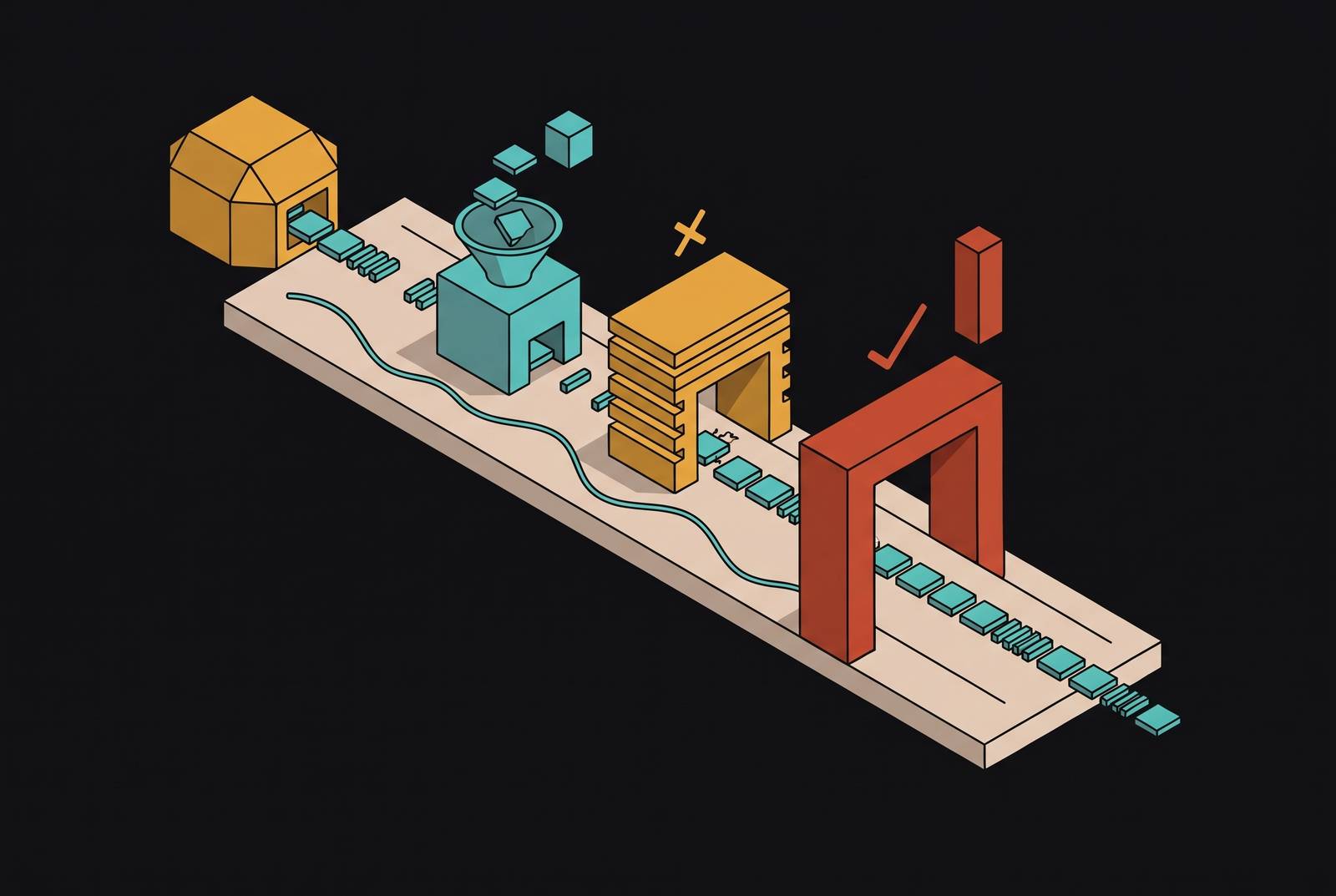
To test agent changes against real production traffic before deploying, replay captured production traces against the changed prompt, model, or tool schema, then score individual spans and check historical regression cases. Comparing agent eval tooling on this axis separates evidence-grounded evaluation from output-only approximation. Tools that make replay a first-class primitive connect production failures to attributable causes and validated fixes, rather than leaving engineers to infer causes from final answers.
Why output-only evaluation fails for agents in ways it never did for single-call LLMs
A single-call LLM evaluation can judge the response as its main object, but an agent makes a sequence of decisions before producing that response. A malformed tool argument, misattributed product feature, or bad sub-agent handoff can corrupt the execution while the final answer passes a surface check. The answer can conceal a broken process. A correct output therefore does not prove that the agent chose the right tools, followed task constraints, or took sound intermediate steps to reach its answer.
That gap follows from the structure of agent execution. Agents produce trees of parent runs, tool calls, sub-agents, retries, and branching paths. Flattening those trees into a timeline removes relationships needed to distinguish a causal error from its downstream effects. Provider updates can also change how the agent behaves before they change the quality of its answers.
Why trace replay specifically is the minimum unit of evidence for diagnosing agent failures
Traditional logs cannot reproduce non-deterministic LLM failures with the fidelity that diagnosis requires. A replayable trace must join the reasoning trace, tools considered and invoked, arguments, returned responses, token use, and latency into one hierarchy. Each step needs its surrounding execution context. Without that context, an engineer can locate an error message without locating the decision that made the error inevitable.
The distinction is clear in a failed web search task. The final agent may report “no results found,” while the actual cause is an upstream agent that formulated an overly restrictive query. Blaming the reporting agent confuses the symptom with its source. Correlation-based diagnosis can make the same mistake because the failure is visible downstream of the decision that went wrong. Root-cause attribution instead requires testing plausible explanations against the full trace and rejecting those contradicted by the evidence.
Replay makes that search more than a retrospective reading exercise. Reproducing the call sequence and tool invocations gives the evaluator the execution needed to examine both the causal step and its eventual consequence. Summary logs cannot supply that missing structure. If replay is the minimum unit of diagnostic evidence, whether a tool treats it as a first-class primitive or an afterthought becomes the right comparison axis.
What "treating replay as a first-class primitive" actually means in a production eval tool
A replay-first tool can reproduce a captured execution, branch from a point within it, and score the changed run against the original. Deterministic replay keeps other conditions the same while a prompt or model changes, so the comparison rests on evidence. Pausing and branching are therefore diagnostic controls.
Span-level scoring assesses tool selection, argument correctness, retrieval relevance, and planning coherence independently, rather than allowing a plausible final response to obscure an intermediate defect. Replay without those scores leaves another run for someone to make sense of. It does not, by itself, establish whether the changed behavior corrected the original problem.
Production failures should flow into evaluation datasets and become regression tests automatically, with metrics defined the same way before deployment and in live traffic. Otherwise, a diagnosed failure can ship again. CI/CD integration belongs within this definition because a quality gate must be able to block a regression before the change reaches production.
The three failure categories that only replay-grounded eval reliably catches
Tool schema drift and argument rot can go unseen in output checks because malformed arguments do not always cause hard failures right away. Truncated JSON, missing required fields, and wrong data types may propagate through downstream steps without an error at the tool boundary. The final response can hide the defect. Replaying the exact argument payloads provides the evidence needed to distinguish a schema change from a failure in the model’s reasoning.
Prompt ambiguity is also hard to spot from the answer alone. Failures in verification, query construction, inter-node handoff, and output formatting can share an underdetermined behavioral expectation in the system prompt. Comparing replayed traces where the ambiguous branch was taken with those where it was not reveals which expectation the prompt failed to specify.
Workflow and planning loops hide their causes across handoffs. In multi-agent systems, planner-to-worker specification drift occurs when an orchestrator delegates through ambiguous natural-language histories rather than deterministic state contracts, corrupting task constraints and masking silent tool errors. The failure may be visible several turns after the handoff. Full-trace replay reconstructs which handoff corrupted which constraint, rather than assigning blame to whichever worker finally exposed the problem.
How the tools compare when replay capability is the primary axis
Tier 1 builds on replay as an architectural primitive and links it to span-level scoring, regression datasets drawn from production, and CI/CD gates. Tier 2 provides replay but leaves more of the evaluation and correction loop to engineers. Tier 3 offers tracing and a view of how the system runs, but lacks replay-grounded evaluation.
Confident AI occupies the replay-first end of this comparison. Its agent evaluation capabilities score individual tool calls, reasoning steps, and retrieval decisions within a trace, using agent-specific metrics in place of repurposed RAG metrics. Execution-tree visualization preserves the structure that flattened logs lose. Multi-turn simulation and CI/CD regression detection connect evaluation to release decisions, while trace review supports participation by PMs and QA without engineering involvement. The closed-loop criterion is whether production failures enter evaluation datasets and are tested under the same metric definitions before they can ship again.
AgentOps sits in the middle of the spectrum. It offers time-travel replay debugging through an open-source Python SDK, but presents itself mainly as a tool for runtime monitoring rather than for making improvements based on evaluation. Replay is available for investigating a run. The distinction from the replay-first tier is the remaining work between reproduction and a validated correction, including interpreting what the replay revealed and driving the fix through regression evaluation.
Datadog LLM Observability and AgentMesh address different operational needs at the tracing end. Datadog emphasizes alerting and enterprise stack integration, making it relevant to teams with existing APM and SRE tooling, but it does not provide span-level agent evaluation or replay-grounded quality gates in this comparison. AgentMesh focuses on multi-agent cost governance through real-time dashboards, circuit breakers, and parent-child span relationships, with limited emphasis on prompt management or evaluation. Teams needing diagnostic quality scoring must pair them with another layer rather than treating operational tracing as a substitute.
What span-level attribution adds beyond replay — knowing which harness layer failed, not just that a run failed
Replay reproduces the failure, but attribution identifies which layer needs correction. The harness comprises six distinct failure surfaces, namely the observation interface, context manager, control loop, action interface, state and artifact store, and verification and governance layer. Calling all of them “the agent” obscures the repair target. A useful diagnosis connects the faulty span to the responsible prompt, tool schema, workflow, memory policy, or model.
That connection requires more than highlighting a span with an error. The evaluator must test whether the prompt left behavior underdetermined, the schema drifted, stale context entered through memory, or a workflow handed off insufficient state. Different causes can lead to the same wrong answer. Even when replay is available, final-output scoring cannot distinguish those causes on its own. Without layer-level attribution, a team may edit the prompt to compensate for a schema defect, see no improvement, and incorrectly conclude that retraining is necessary.
Why harness iteration validated against replay beats both retraining and unvalidated prompt edits
For production failures rooted in prompts, tools, workflows, or memory, replay-validated harness iteration is the appropriate first response because it targets the layer responsible for the defect. It is faster, cheaper, and safer for this class of problem than treating every failure as a model limitation. Architectural defects can survive model upgrades. The evidence on cloud root-cause analysis in the notes shows the main failures across model capability tiers, while richer communication protocols cut down on communication failures that prompt engineering had failed to remove.
Retraining nevertheless has a legitimate, narrower role. Pioneer Agent (2026) demonstrates a systematic, multi-week engineering process that queries production traces, constructs a failure taxonomy, probes weaknesses, synthesizes corrective training, retrains, and evaluates against both the failure set and a regression holdout. It is appropriate when the confirmed weakness cannot be addressed at the harness layer.
The practical response is therefore to reproduce the failure, attribute it to a layer, generate a candidate fix, and validate that fix against historical traces including regression cases before shipping. The validation step is indispensable. A prompt edit may fix the case at hand while breaking a historical conversation that the team never retested by hand.
Pre-production evaluation and live alerting do not automatically complete this loop. Monte Carlo supports pre-production evaluations and in-production quality alerting, but its described feature set does not include automatically converting failing production traces into regression tests. That distinction changes the release workflow. The presence of evaluation and monitoring in one platform does not establish that failures flow automatically into the tests used to approve a fix.
How do you test agent changes against real production traffic before deploying?
For teams choosing or auditing a stack, the operational test starts with a specific historical failure. Can the tool replay that failure deterministically, preserving the captured spans, arguments, and tool invocations as the baseline for a changed prompt or schema? The baseline must be concrete enough to compare. A trace viewer that displays the failed conversation but cannot reproduce its execution does not meet this test.
Does it score tool selection, argument correctness, and retrieval relevance independently, and does it attribute the defect to a prompt, tool, workflow, or memory layer? Finally, does it validate the proposed correction against historical failures and regression cases before recommendation or deployment? These questions separate reproduction from validated improvement. Where engineers must manually assemble every connection, the stack is providing evidence but has not closed the loop.
Teams already using tracing-only tools need not start by replacing them. SDKs compatible with an open tracing standard keep trace data portable, and many replay-first and replay-capable tools accept traces in that standard format from external sources.