Harness Layer Checkpoints That Intercept Silent Tool Failures Before Orchestrator State Propagation
Checkpoints between tool return and state write catch plausible but corrupted outputs.
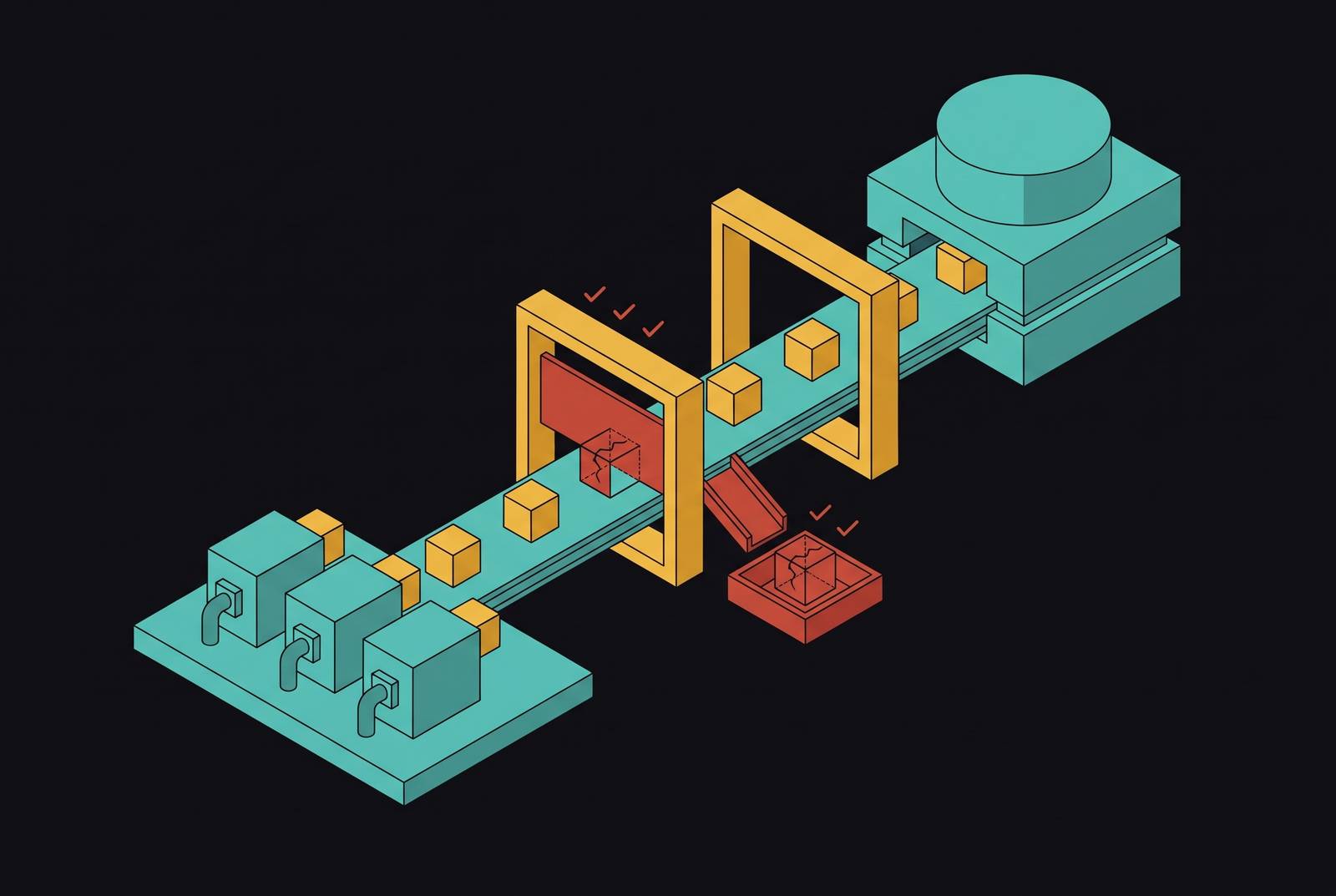
Silent tool failure detection in production multi-agent pipelines requires harness-layer checkpoints between tool return and orchestrator state propagation. A well-formed response is not evidence of a correct result. Checkpoints must preserve the payload, detect and classify violations, and signal recovery before the orchestrator accepts corrupted output as fact.
Why silent tool failures are more dangerous than crashes
A crash is loud, attributable, and stoppable. A silent tool failure returns something plausible enough for the execution graph to accept, so the workflow continues without exposing the defect. Wu 2026 describes the sharpest version as “fail-plausible,” Class D in a five-class taxonomy. In one documented incident, an HTTP 400 error page captured into a cache became a fabricated industry analysis about a “Hugging Face platform crisis.” The system delivered it as a routine insight digest, with no detector firing and every test staying green.
The model did more than forward an error. It transformed corrupted input into a fluent, confident narrative, obscuring the evidence that might have exposed the failure. In a multi-step chain, downstream tools can accept the corrupted output, misinterpret a field, and pass a further-degraded result forward until recovery becomes difficult. Liu 2026 links this risk to language-based autonomous systems that run without external deterministic constraints, so it goes beyond an implementation defect. That framing places responsibility for controlling how tool results cross into trusted execution state at the harness layer.
How the orchestrator's trust model turns a bad tool result into corrupted state
The orchestrator accepts a well-formed tool response as an observation because it has no built-in contract for what that response should mean. Format becomes a proxy for validity. Panthi & Abdelfattah 2026 distinguish readily visible timeouts from contradictory, stale, or physically impossible results that arrive in the expected format. Without an external contract, the agent cannot tell those results from correct ones. Writing the observation into execution state therefore converts an unchecked tool claim into an input for subsequent decisions.
This trust boundary extends across agents. A failure in one agent’s harness can reach another agent as an apparently valid observation, leaving the recipient unable to see the originating defect. Current orchestrators also lack complete transactional settlement of tool effects under faults, speculation, contention, and irreversibility. Solutions for each mechanism fill only part of that gap. Internal monitoring cannot resolve the whole problem when the execution model has already given the incoming result reason to be trusted.
Wu found that people looking at the user view caught roughly 70% of silent failures in the end, while unit tests, health checks, and governance audits stayed green through most incidents. The same system’s declarative governance layer lacked ex-ante prevention capability but performed strongly at blocking regressions after incidents. Those capabilities serve distinct safeguarding roles. An audit can recognize a failure pattern once that pattern has become a rule, but it cannot supply the missing semantic contract for every new response. The orchestrator’s continued execution is consequently not evidence that its observations remain sound.
The three failure categories that harness checkpoints must cover
Schema drift occurs when an API changes its response shape and the tool parser misreads the new payload without throwing an exception. What looks like a model error comes from a field mismatch between the live API and the harness schema. Old mocks conceal the change during CI. A production trace exposes the discrepancy because it contains the response the parser actually received. Detection therefore needs structural checks against the tool’s current contract as well as a check of the final answer.
Prompt ambiguity presents a different detection problem. Without a clear reference for the intended instruction, a failure can resemble a limit in model capability when the prompt was simply underspecified. A model upgrade does not correct that ambiguity. The checkpoint needs both a valid response shape and a reference for expected behavior.
Workflow loops require attention to execution over time. Signs include calls to the same tool over and over, the same parameters on calls in a row, repeated edits to one resource, and a step count that keeps growing while the task goes nowhere. An individual return may still look entirely valid. These patterns need behavioral signals that span calls as well as checks of each payload. Panthi & Abdelfattah found that detection outside a mined contract vocabulary falls sharply, reinforcing the need to combine known contracts with signals that do not require the precise failure shape to be specified in advance.
Where in the execution lifecycle checkpoints must be positioned
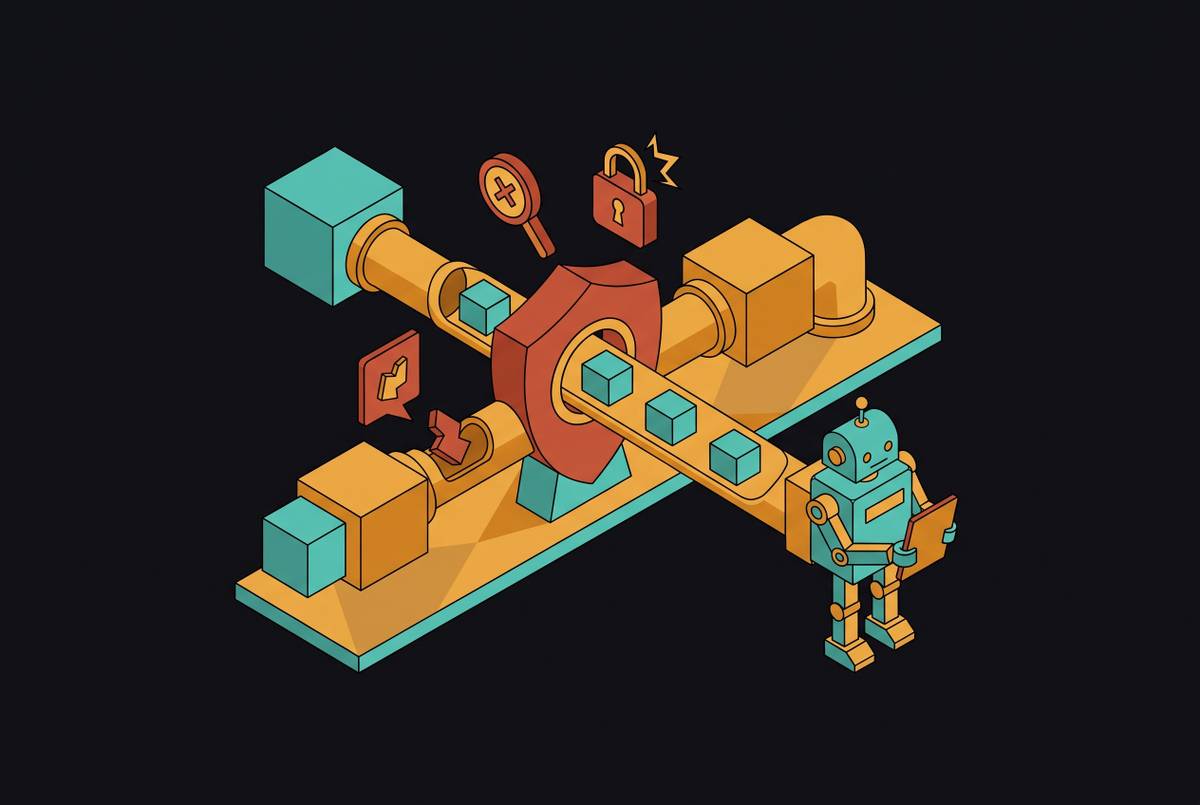
The effective interception window is post-return, pre-propagation. Without interception, the sequence is tool execution, tool return, state write, and downstream action. With interception, a harness checkpoint sits between the return and the write, so the observation is checked before it becomes trusted state. Lifecycle hooks provide this boundary without coupling validation and policy enforcement to the component logic they guard.
Pre-call checks cannot inspect a result that has not arrived, although they can catch schema mismatches in outbound calls. Post-write checks face the opposite problem. The corrupted observation is already part of execution state, and recovery may require unwinding state that has triggered side effects. Panthi & Abdelfattah formalize a “detect and advise” interface in which a deterministic detector checks a returned result against an invariant and appends an advisory receipt before the agent acts. The monitor neither removes actions nor selects a repair, so the surrounding harness must distinguish advisory detection from the decision to halt propagation.
Checkpoints at meaningful transitions also establish verified recovery positions. Execution can resume from the last known-good state rather than restarting or continuing from an unknown corrupted point. Replay introduces a separate constraint. Tool calls must be safe to run more than once because, after a crash, the harness may not know whether the last call executed. Idempotency belongs in checkpoint design.
What a harness-layer checkpoint must do at the interception point
The first function is to preserve the raw result. Panthi & Abdelfattah require the monitor to retain the payload and issue a nonbinding receipt. Diagnosis and replay depend on that original return. The second function is to detect a violation against an outcome contract, including a negative price, an impossible timestamp, or a missing required field. A receipt that names the violated property and gives a witness such as “expected ≥ 0, observed -3” localizes the defect without requiring model judgment to establish it.
The third function is to classify the failure. Schema drift calls for schema repair or a fallback, while a workflow loop calls for a halt and step-count reset. A semantic violation calls for a retry with an alternative tool or a reduced confidence score on the result. Without this distinction, the agent can fall back on making the same malformed call over and over, spending tokens without getting anywhere.
Panthi & Abdelfattah found that the list of named recovery tools in the receipt was what helped the agent complete more tasks. A witness alone produced no measurable gain, and removing the recovery-tool list eliminated the effect while restoring it recovered the effect. The receipt remains advisory, leaving the agent’s choice inspectable and recovery auditable. A self-healing orchestrator can then preserve execution state, apply a bounded recovery action based on classification, and verify whether execution can safely continue.
Mining outcome contracts from production traces rather than writing them by hand
Production traces show how tools behave in ways that API specifications and developers’ expectations can miss. They provide evidence for relationships between calls and results. Panthi & Abdelfattah use task-disjoint cross-fitting, mining contracts from nominal execution traces that do not overlap with evaluation tasks. That separation prevents the detector from being judged on the same cases used to derive its expectations. Public OpenAPI specifications and JSON Schema definitions complement this evidence by supplying structural contracts before production history exists.
Mined contracts nevertheless have a firm limitation. Panthi & Abdelfattah report sharply reduced detection outside the mined vocabulary on incidents drawn from a published failure taxonomy. The practical response is a layered strategy that combines mined behavioral contracts for known interactions, public schema contracts for structure, and behavioral anomaly signals for residual risk. Step count, token consumption rate, and repeated identical calls broaden detection without pretending that the contract vocabulary is complete.
Because of that limit, contracts need upkeep after the first detector ships. A failed call can trigger a memory write that records what was happening when it failed, keeping the evidence for later study. Repeated failures can expose a contract gap. The trace that revealed the gap then becomes the basis for a revision, connecting the rule to observed behavior. Contracts are therefore maintained engineering artifacts, with production evidence supplying both their initial constraints and the reasons to change them.
Validating checkpoint changes against historical traces before shipping them
A checkpoint change can itself introduce silent failures or unnecessary halts. False negatives pass the defects the checkpoint was designed to catch, while false positives interrupt valid executions. The deployment discipline is replay-based validation. A team takes a production trace, applies the checkpoint change, reruns the trace, and checks that it catches known-bad runs while letting known-good runs pass.
Wu found an 87% ex-post regression-blocking rate for the declarative governance layer, reflecting its use of known failure patterns from postmortems. In the same system, incident latency was linked to the failure mechanism rather than how complex the code was, and failures between components lasted the longest. Deployment topology, cross-script contracts, and observer-observed coupling were seams where tests did not run. Replay coverage should therefore include these boundary cases along with the behavior of tools on their own.
The checkpoint should fire on every trace class it was designed to catch and pass a representative sample of clean traces. Its receipt should name the property that was violated and give a valid recovery-tool list. Isolation is another explicit acceptance criterion. The checkpoint must support replay without running the tool call again, so its decision can be checked against the saved evidence without repeating the tool’s effects.
Treating recurring checkpoint violations as a signal for systematic harness repair
A halted failure is also evidence about the harness. Recurring violations identify where a durable repair belongs, provided the record attributes the cause to the prompt, tool schema, workflow, or memory layer. Malformed tool calls point toward tighter schema enforcement, while loss of coherence over a long task points toward redesigning the compaction strategy. Generic prompt adjustment and retry cannot substitute for that attribution. Without structured observability over violations, the harness remains a static scaffold because the evidence needed to revise it never forms a usable feedback loop.
ReHarness formalizes continual harness revision through source-grounded changes that correct overgeneralized or outdated experience under distribution shifts. Harness Continual Learning (HCL) treats the mutable harness as a unified learning state and evaluates retention across committed updates. Both approaches depend on evidence for revision. Checkpoint violation patterns supply that evidence by connecting failed execution to the component that needs to change. The objective is not simply to accumulate more rules, but to repair the source of recurring failures without losing behavior that already works.
The notes’ comparison with model retraining supports this focus on harness iteration. Reflecting on execution trajectories in natural language and mutating prompts outperforms reinforcement learning (GRPO) on average by +6% across six tasks while using up to 35× fewer rollouts. That finding supports using trace evidence to choose where to change the harness before assuming that model weights are at fault. Systematic checkpoint violation analysis deserves the same rigor as code review, so each incident strengthens the execution system.
Sources
- When Errors Become Narratives: A Longitudinal Taxonomy of Silent Failures in a Production LLM Agent Runtime
- Silent Failure in LLM Agent Systems: The Entropy Principle and the Inevitable
- Outcome Monitors: Recovery Affordances for Silent Tool Failures
- Atomix: Timely, Transactional Tool Use for Reliable Agentic Workflows
- Self-Healing Agentic Orchestrators for Reliable Tool-Augmented Large Language Model Systems
- Agent Harness for Large Language Model Agents: A Survey[v3]