Ranked Issue Backlog Tools for Production AI Agents
Turn production agent traces into a prioritized repair queue with correct attribution.

Ranked issue backlog tools for production AI agents turn traces into a repair queue, but their value depends on correct attribution and production-impact ranking. A compounding improvement loop from production agent observability requires detecting failures, locating the responsible layer, proposing a repair, and replaying historical cases before deployment. Monitoring alone cannot close that loop.
Why standard observability tools leave engineers doing attribution work manually
A support agent calls an internal billing API and returns a completely wrong summary. Nothing crashes or sets off an alert, and the dashboard stays green. Latency stays low and error rates stay near zero because the service carried out the request. The failure is in the content. Traditional application performance monitoring answers whether a service is up and fast, but it cannot establish whether the answer is correct.
Engineers are left to track down failures through signs that conventional monitoring misses. A tool-argument mismatch, such as customer_id being renamed to account_id, can produce a drop in task completion and more retries without an obvious crash. Context truncation can drop key instructions or retrieved documents without any sign that they are gone. Runaway loops can use up tokens without triggering a 5xx.
Even a complete trace does not settle responsibility. The step where the error becomes visible may not be the step that caused it. A bad final response might come after a tool mismatch, retrieval that brought back the wrong material, or an instruction that was missing. Engineers must search backward through the execution and distinguish the originating fault from its consequences. A log browser exposes that evidence but leaves the attribution work to its reader.
What a ranked issue backlog for agents actually does, and how it differs from a trace viewer
A ranked issue backlog scores production runs, groups failures into named patterns, and puts those patterns in order by their production impact. Its output is a prioritized repair queue. Unlike a trace viewer, it must connect execution evidence to an actionable issue rather than simply make individual runs easier to inspect. That requires automatic failure detection, issue clustering, and layer attribution.
Detection scores every run, or a sample that represents them, using quality metrics as well as error codes. Clustering groups bad runs into patterns such as wrong tool calls, hallucinations, retrieval misses, frustrated users, and new unhandled intents. Attribution identifies whether the cause lies in the prompt, tool schema, workflow, memory or retrieval layer, or model itself. These capabilities depend on one another. Mixing tool-call failures with bad final responses obscures the fact that they can require different repairs.
Ranking then makes a separate judgment about priority. A rare failure that blocks a high-value workflow can outrank a frequent nuisance that users work around. Short replies, repeated rephrasing, and explicit complaints such as “that's not what I asked” provide impact evidence that error counts omit. New unhandled intents reveal a different problem. They are coverage gaps that may still meet existing expectations.
The six failure categories a ranked backlog must be able to distinguish
Tool-call failures begin when the model emits invalid arguments and receives an error, then loops or fabricates a result. The repair belongs in the tool description or schema. Prompt ambiguity has a different signature. Underspecified instructions produce confident but wrong outputs across a class of inputs, pointing to the system prompt or task framing.
Schema drift deserves separate treatment because an interface change can degrade behavior without producing an obvious crash. Renaming customer_id to account_id creates a mismatch between the expected argument and the tool contract. The agent can sound confident while accomplishing less. Task completion drops and retries increase, but an uptime dashboard has no reason to object. Attribution must identify the changed contract rather than treat each disappointing answer as a generation problem.
Context truncation removes information the agent needed because the prompt reached the context window. Its repair lies in memory or retrieval architecture, or prompt compression. Runaway workflow loops instead expose a failure to converge. Calls that repeat with small changes use up tokens and point to routing and termination logic.
Retrieval misses complete the taxonomy, covering plausible but ungrounded answers produced from irrelevant retrieved context. The repair belongs in retrieval. Execution auditing is needed for all six categories. A correct-looking final answer can conceal a bad tool call, a hidden retry loop, or an ungrounded intermediate assumption. Output grading alone misses faults that recur across runs and create silent reliability drift.
How attribution breaks down in practice, and why the diagnosis-to-recovery gap is the central unsolved problem
Attribution is a search problem in which a system must test plausible explanations and rule out contradictory evidence before selecting a cause. As execution logs become larger and more distributed, it becomes easier to stop at a plausible-looking failure without exploring the evidence fully. The R2Act study found that even the strongest retrieval-assisted attribution systems achieved very high root-cause service accuracy while recovery validity remained markedly lower. Naming the broken layer did not reliably produce a valid repair.
Research approaches address different parts of that difficulty. HPFA, a failure attribution method presented at COLM 2026, contrasts successful and failed trajectories to localize LLM reasoning failures. AgentDebugX, an open-source toolkit published on arXiv in 2026, escalates hard cases to a multi-turn diagnostic agent called DeepDebug. DeepDebug produces an auditable root-cause report with evidence and a recommended fix. AgentDebugX reports that its multi-turn approach outperforms the strongest single-pass baseline on exact agent-and-step attribution accuracy on the Who&When benchmark.
Engineers should ask whether a tool generates a concrete, inspectable proposed fix and validates it against historical traces before recommending deployment. A named issue is not a shipping decision. Without a reviewable remediation proposal or a replay mechanism, the tool delivers only part of the workflow. Black-box auto-fixes restore the guesswork that attribution was meant to remove.
What the harness frame reveals about where ranked backlogs should look first
The harness is the seven-component layer around the model, including the prompt, tool description, tool implementation, middleware, skill, sub-agent configuration, and memory. It is the dominant source of production agent failures. “Model failure” is usually too coarse a diagnosis. Even “prompt” can misdirect a repair when the actual fault sits in a tool description or sub-agent routing rule. A useful backlog identifies the component engineers can change.
Terminal Bench 2.0 shows how much can improve while the base model stays the same. The gains came from harness engineering through self-verification, tracing, better retry logic, structured termination rules, and disciplined tool usage. Recursive Harness Self-Improvement, identified as arXiv 2607.15524, found that low-reasoning-effort agents could beat the maximum-effort configuration after a few harness iterations while spending up to 60% less on inference. Harness iteration can improve both behavior and cost. That makes component-level attribution consequential for repair priority.
The repair path also differs by component. Typed schemas such as Pydantic and JSON Schema cut tool errors, locating the intervention in the tool description layer. Continual learning updates procedural memory from one session to the next without full fine-tuning. A backlog that collapses these cases into a generic model issue hides those options.
Harness-first attribution does not guarantee that iteration will succeed. Harness evolution algorithms do not reliably unlock previously unsolved tasks, and some test sets show only marginal gains. Results also degrade when the improvement signal lacks an independent correctness check. This is the strongest constraint on the approach. Historical replay must give a trustworthy correctness signal as well as show that the changed agent can execute.
How do teams use replay to turn ranked issues into shipped fixes?
Replay tests a proposed change on past production cases before it is deployed. An agent evaluation harness connects offline evaluations with observability by joining task runs to trace and span IDs and incident signals. Recorded tool outputs and sandboxed side effects make the test stable and keep it separate from live consequences.
Evaluation replay tests a new prompt, model, or tool policy on old cases. It is not equivalent to reproducing the original execution exactly, and presenting the two as interchangeable produces misleading validation results. A tool must make the distinction explicit.
Tail-based sampling keeps every failed, expensive, or anomalous trace in full but keeps only a small sample of the happy path. The failures contain the strongest repair signal. Scheduled replay of a golden trace set against current production then provides early warning of silent drift from model updates, prompt edits, and tool schema changes.
LOOP, identified as arXiv 2605.14237, offers a related distinction between authoring and execution. Its premise is that LLM reasoning is most valuable for authoring a workflow. Separating LLM-driven, one-time design from deterministic, zero-token execution aims to combine flexibility with production reliability. This is distinct from testing a modified policy on historical cases. Both approaches require clarity about what changes and what the execution holds fixed.
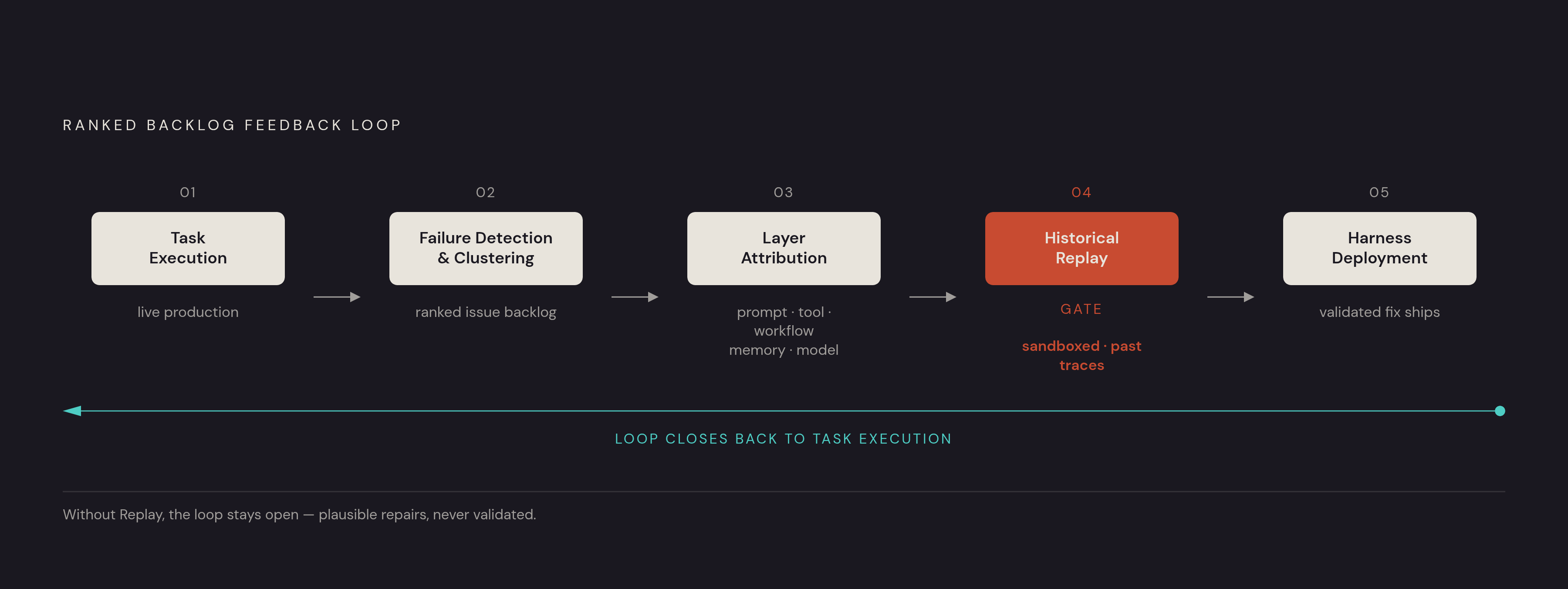
The improvement loop proceeds from task execution to evaluation, a proposed harness change, historical replay, and deployment of the updated harness. Replay is the gate between a plausible repair and a validated change. Continued production evaluation then supplies the next set of failures and coverage gaps, allowing prompt and logic improvements to build on evidence from earlier runs.
What to look for in a ranked backlog tool — the evaluation criteria that separate genuine attribution from observability theater
Automatic failure detection is the first criterion. A tool must score correctness, tool-call validity, sentiment, and groundedness, cluster failures into named issues, and alert on quality drops without requiring engineers to read every trace. Confident AI’s 2026 overview identifies issue detection and quality-aware alerts routed to where the team works as baseline capabilities. Latency and 5xx alerts are not substitutes.
Layer-specific attribution and impact-based ranking are the next two criteria. Attribution must name the harness component at fault, while ranking must weigh how often failures happen, how severe they are, and what they cost the business, along with raw error counts. These are separate tests of usefulness. A tool can diagnose correctly yet prioritize poorly, or rank an urgent issue without locating its cause. That assessment must include sentiment signals and new unhandled intents because production impact includes more than explicit failures.
Reviewable remediation proposals and replay validation complete the five criteria. Engineers need specific changes they can inspect, then sandboxed tests on past production traces before a tool recommends deployment. Auditability allows engineers to compare the proposed intervention with the evidence supporting the diagnosis.
Does the tool distinguish evaluation replay from exact replay and support scheduled tests of a golden trace set? Does it surface new intents and coverage gaps, and can non-engineers participate in triage without reading raw traces? These questions test the workflow beyond diagnosis alone. The value of a ranked backlog is that it supplies the right evidence, in the right order, at the right layer, to inform engineering judgment.